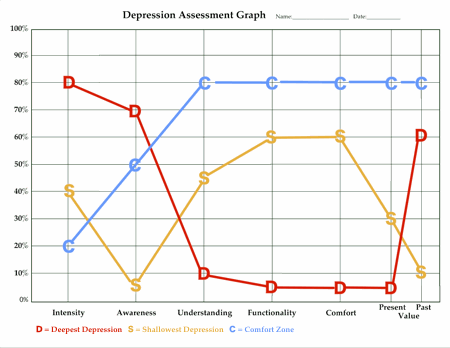
One of the foundational concepts in the Bipolar IN Order framework is the comfort zone: the range of emotional and energetic intensity within which you can function effectively and feel relatively grounded. Understanding your comfort zone precisely — not just roughly — is the starting point for all meaningful work in the program.
What the Comfort Zone Actually Measures
Most people have an intuitive sense of when things feel manageable and when they do not. But this intuitive sense is often vague, and vagueness is a limitation when the goal is deliberate development.
The comfort zone in the Bipolar IN Order framework is defined more precisely as the range of intensity — from 0% at complete baseline to 100% at maximum crisis intensity — within which you can demonstrate:
- Awareness of your current state (you know where you are)
- Functionality (you can carry out the normal responsibilities of your life)
- Comfort (the state is not causing significant suffering)
- Value (you can find something of value in the experience rather than experiencing it as pure loss)
These criteria apply separately to both depressive and elevated states. Your comfortable range on the depressive side may be different from your comfortable range on the elevated side.
The Assessment Process
Assessing your comfort zone systematically requires working through multiple levels of intensity across several dimensions:
Recognize and describe each intensity level. Starting with very low intensity — barely noticeable shifts — and working up through progressively more intense states. The goal is to be able to accurately describe what 10%, 20%, 30% intensity looks like for you specifically. What are the physical sensations? The thought patterns? The emotional qualities? The behavioral tendencies? This level of descriptive clarity is more demanding than it sounds, and it takes time to develop.
Assess functionality at each level. For each intensity level, be honest about what you can and cannot do. Can you work at 30% elevated? At 40%? Can you maintain your most important relationships at 30% depressive? At 50%? The functionality assessment should cover all six domains: physical, mental, emotional, spiritual, social, and career/financial.
Identify your current outer boundary. Where does the range of manageable experience currently end? This is the edge of your current comfort zone — not the place you want to live, but the current outer limit of what you can handle while remaining functional and aware.
Why Precise Measurement Matters
Vague self-assessment leads to vague interventions. If your sense of your comfort zone is "things are fine until they're not," you have no early warning system and no basis for targeted practice.
Precise self-assessment — knowing that you are currently at roughly 30% depressive intensity, that your functional range extends to about 40% on that side, that your typical early warning signal is a specific pattern of sleep change and irritability — gives you and your treatment team something to work with.
It also creates a baseline against which progress can be measured. If your functional range on the depressive side has extended from 30% to 45% over the course of a year of sustained work, that is a meaningful and documentable improvement — even if episode frequency has not changed.
Expanding the Comfort Zone
The goal of the Bipolar IN Order program is not merely to assess the comfort zone but to expand it over time. This expansion happens through deliberate, graduated practice: taking small steps slightly outside the current comfortable range, using tools to maintain functionality within those slightly extended states, and then returning to the comfort zone to integrate what was learned.
This is slow work. The comfort zone expands in increments, not in leaps. But the expansion is real and measurable, and it represents genuine growth in the capacity to live well with bipolar disorder.