Program Features
Users build personalized profiles of their environments, behaviors, comfort zones, and tools — creating a self-management system specific to them. The program works alongside clinical care, not as a replacement for medication or therapy.
Core Program
Structured Education
Lessons are sequential educational content (video + reading, numbered 1.0 through 8.8). Exercises are interactive forms embedded within lessons that require user input before advancing. Exercises build the user's personal profile — rating environments, identifying behaviors, setting comfort zones, selecting tools, configuring timeline settings.
Daily Check-ins
A daily check-in takes about 30 seconds and captures where you are right now — your mental state, what's going on around you, and how you're handling it. Over time that builds a personal dataset that drives the AI coaching, reports, and pattern recognition.
Comfort Zone Management
Each user defines personal functioning thresholds for their condition states. The app tracks when check-ins show them inside, slightly outside, or too far outside their comfort zone.
Behavioral Awareness
Recognize when Dis-Ordered behavior is approaching and learn how to shift consciously into IN Order responses. The program tracks behaviors toward others and toward self, helping you see patterns before they escalate.
Environments
External context factors — location, social setting, atmosphere, activity — that users rate during exercises for how they affect mania vs. depression separately. Tracked over time to identify patterns. Users can add provisional environments beyond the pre-built library.
Features Unlock as You Go
Features unlock as users progress through the program's lessons — starting with daily check-ins, then opening up tools, reports, and the timeline system. This keeps the experience from being overwhelming early on and ensures users understand each feature before they get access to it.
Everything Is Paired — Mania and Depression Separately
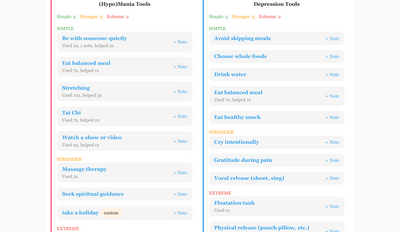
Almost everything in the program is paired. Mania and depression have separate tool selections, environment ratings, timeline settings, and comfort zone thresholds. This reflects that bipolar symptoms are directional — what helps during depression may not help during mania, and vice versa.
Your Personal Toolbox
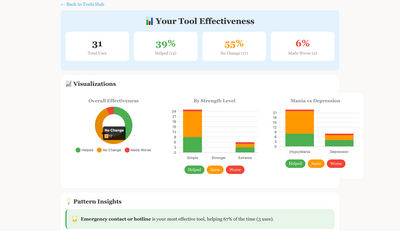
The program includes a library of coping tools organized by strength level — from simple everyday strategies to stronger interventions for more intense states. You select the tools that work for you, track which ones keep you IN Order, and build a personalized toolbox over time. As you check in daily, the system suggests tools based on your current state and comfort zone.
Graduated Timelines
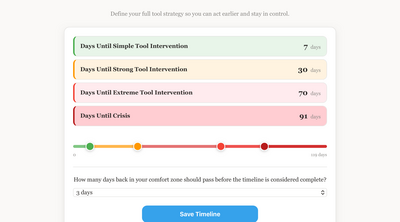
When check-in data shows a trend outside the comfort zone, the program walks the user through a stepped response — starting with awareness, progressing to stronger tools when needed.
AI Coaching
AI-assisted reflection that reinforces self-awareness and helps users recognize patterns. Explicitly scoped to coaching — not clinical advice.
Reports You Can Share
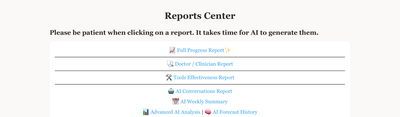
The app generates reports that show users how they're doing over time — mood trends, which tools are working, behavioral patterns, and AI-generated insights. Users see their own data. Partners see aggregate outcomes across their cohort — engagement, cost savings, tool effectiveness — but never individual check-in data or conversations.
Users can share their check-in data, tool usage, AI coaching conversations, and reports with therapists, doctors, family, or researchers — choosing exactly what each person can and cannot see. A therapist might get the clinical report and tools data. A spouse might see only the weekly summary. The user decides, and can revoke access at any time. All access is logged for HIPAA compliance.
Privacy & Security
HIPAA-compliant architecture: bcrypt password hashing, TOTP two-factor authentication, CSRF token rotation, PDO prepared statements, rate-limited login, Cloudflare Turnstile CAPTCHA. Config files stored outside the web root. Role-based access controls separate user, partner admin, and system admin capabilities. All authentication events and data access are audit-logged.
Ready to Start?
Helping people improve their lives since 2003.
Join the Program