Remission is a genuine achievement. Anyone who has worked hard to bring their bipolar symptoms under control deserves to recognize that accomplishment.
But remission is not the same thing as Bipolar IN Order — and understanding the difference matters for what you aim for next.
What Remission Means
The National Institute of Mental Health defines remission in bipolar disorder as the reduction or elimination of manic and depressive symptoms to the point of being nearly symptom-free. This is what clinical treatment is primarily designed to achieve.
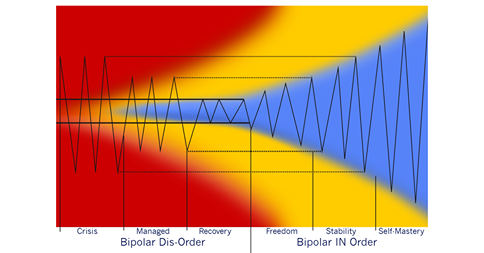
Remission is important. It represents a significant reduction in suffering and a meaningful improvement in quality of life. The three stages of Bipolar Dis-Order — Crisis, Managed, and Recovery (remission) — each represent real progress.
But the NIMH's own landmark STEP-BD study found that recovery is an unstable state: "In spite of modern, evidence-based treatment, bipolar disorder remains a highly recurrent, predominantly depressive illness." People who reach remission frequently cycle back into more difficult states. This is not a personal failure — it is the nature of the condition.
The problem arises when remission is treated as the final destination. When it is, people are often poorly prepared for the next cycle, having invested no energy in building skills that would serve them during difficult states.
What Bipolar IN Order Means
Bipolar IN Order begins where remission leaves off. Rather than focusing only on reducing intensity — bringing the highs lower and the lows higher — it focuses on expanding functionality: becoming more capable, more comfortable, and more grounded across a wider range of states.
The three IN Order stages are:
Freedom Stage — Learning to take small, supervised steps into slightly elevated states (typically 10–20% intensity) and return to baseline using your own skills. This requires careful assessment and a toolkit built for the purpose.
Stability Stage — Reaching a level of functionality and comfort during states that once caused full crisis. This takes sustained work and time, but it has been achieved by many people. Stability means the condition is no longer in disorder, even though bipolar states still occur.
Self-Mastery Stage — Functioning effectively at intensities approaching what once represented the outer limits of crisis. This is the advanced stage, analogous to the difference between a recreational hiker and someone who climbs the Himalayas. Not everyone pursues it, and not everyone needs to. But it represents the full upper boundary of what is possible.
A Common Misconception
A mistake I encounter regularly is people assuming they are already in Bipolar IN Order when they are in remission. The feeling of stability that comes with remission can be convincing. But the criteria for IN Order are specific: the ability to clearly distinguish between intensity levels, demonstrate functionality and awareness across those levels, behave in ways that those around you can be comfortable with, and show genuine skill in moderating intensity before it escalates.
Remission is part of the path. It is not the end of it.
Why This Matters
If recovery is the ceiling, then everything built around bipolar treatment is oriented toward a level of outcome that research has already shown to be temporary and insufficient for many people. There is a higher ceiling. It requires more work, more structured learning, and more sustained effort — but it is real and achievable.
The Bipolar IN Order program exists to provide the assessments, tools, and stage-specific plans that make the IN Order stages accessible. Recovery remains valuable as a foundation. It is simply not the end goal.