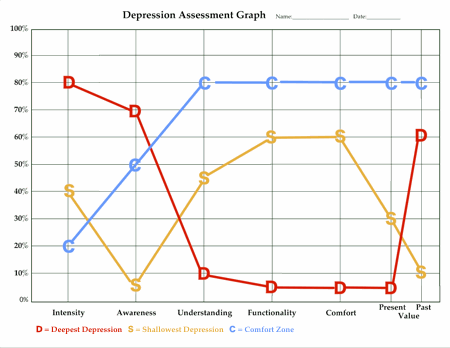
The idea that there is value to be found in depression and mania sounds, at first hearing, either dismissive of real suffering or simply confused. If these states cause harm — and they do — how can they simultaneously have value?
The short answer is that these are not mutually exclusive. Something can be genuinely difficult, even painful, and also genuinely instructive. The two are not in contradiction.
But the longer answer matters more, because how this idea is applied makes the difference between something genuinely helpful and something harmful.
Who This Does Not Apply To
The concept of finding value in difficult states is not appropriate for someone in acute crisis. When someone is at risk, when their safety is not secured, when the episode is at an intensity that overwhelms their capacity to function — the only useful focus is safety and stabilization.
Nothing about finding value in difficult states should be directed at someone in that position. Doing so is not supportive; it is an additional burden on someone who is already overwhelmed.
What Value Actually Means Here
For people who are in more stable phases — who have an established clinical foundation and are working on developing greater capacity — the question of value in difficult states is genuinely useful.
Value in this context does not mean that depression or mania are good things, or that the suffering they cause should be minimized or ignored. It means that the experiences carry information, and that people who learn to extract that information are better equipped over time.
What depressive states can offer:
Depth of reflection that is harder to access during normal or elevated states. A different quality of empathy — having been in the depths makes it easier to meet others there. Clarity about what actually matters, which often surfaces when the usual distractions fall away. Slowed thinking that, while uncomfortable, can support a different kind of careful consideration.
What elevated states can offer:
Enhanced creativity and associative thinking. Heightened energy and motivation that, when channeled appropriately, can accelerate certain kinds of work. A quality of connection and enthusiasm that is genuine and that others often respond to.
None of these are available on demand, and none are guaranteed. But they are real features of these states for many people — features that tend to disappear when the entire focus is on eliminating the state as quickly as possible.
The Practical Application
Learning to recognize and work with these qualities — rather than only fighting the states that carry them — requires a specific kind of practice.
It starts with honest observation: what actually happens during your depressive episodes, in addition to what is difficult? What do you notice about how you think, what comes to your attention, what you are capable of, during that state? The same questions apply to elevated states.
This observational practice is not passive. It requires holding the state with a kind of studied attention that takes time to develop. But the information it generates about one's own patterns, capacities, and needs is genuinely useful — both for self-management and for the treatment conversations that happen with clinicians.
People who have done this work consistently report that their relationship with difficult states changes over time. Not because the states become less intense, but because the relationship to them has shifted from pure opposition to something more nuanced — one that allows for both appropriate management and genuine learning.