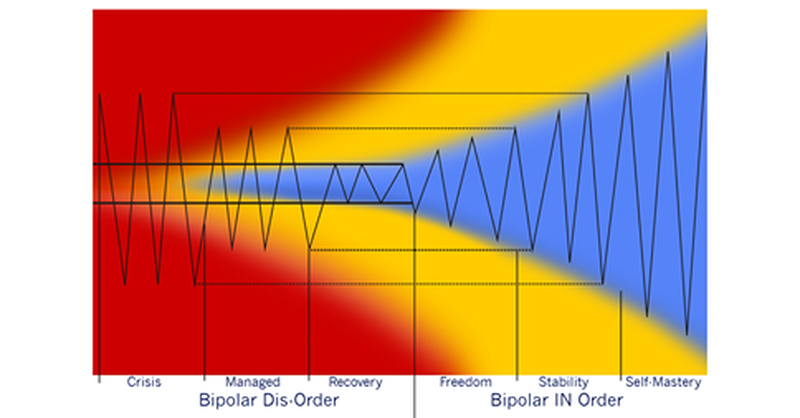
Bipolar IN Order is not a medical term. It does not appear in the DSM. It is a description of a possibility — a different relationship to bipolar disorder than the one the standard treatment model envisions.
Understanding what it actually means, and what it does not mean, is the beginning of understanding what the program offers.
What It Is Not
Bipolar IN Order does not mean cured. People with Bipolar IN Order still have bipolar disorder. They still experience the full range of states — depressive, elevated, and everything in between. The diagnosis has not been removed.
It does not mean unmedicated. Many people with Bipolar IN Order take medication as part of their ongoing clinical care. The decision about medication is a clinical one made with a qualified psychiatrist. Bipolar IN Order does not have a position on medication; it has a position on functionality and skills development, which are separate questions.
It does not mean that episodes no longer occur. Episodes still occur. The condition is cyclical, and that cycling does not stop.
And it does not mean that the person has "gotten over" their bipolar disorder, or that they have achieved something that should be expected of everyone with the diagnosis. Progress with bipolar disorder is highly individual, and the stages of Bipolar IN Order describe a spectrum rather than a fixed destination.
What It Is
Bipolar IN Order describes a condition of being — a state of relationship to the condition — in which:
The person can recognize their states accurately and in real time, across a meaningful range of intensity.
The person can function across that range — not necessarily at full capacity at the highest intensities, but functionally enough to maintain the most important dimensions of their life.
The person is no longer primarily organized around fear of what the condition might bring. Instead, they have a working relationship with their states — one that has been built through years of systematic practice and appropriate clinical support.
The suffering that comes from the condition has been substantially reduced. Not because the painful states no longer occur, but because the person's relationship to those states has changed in a way that reduces the second layer of suffering: the suffering caused by being overwhelmed by, terrified of, and in opposition to the states themselves.
The Six Stages
The Bipolar IN Order framework describes six stages on the path from disorder to order:
Crisis — The state is overwhelming and creating genuine danger.
Managed — Tools are being used to keep intensity below crisis level.
Recovery — Symptoms have reduced to the point of near-absence (remission).
Freedom — Small, deliberate steps outside the comfort zone are being practiced.
Stability — Functionality is maintained at intensities that once created crisis.
Self-Mastery — Functionality is maintained even at near-maximum intensities.
The first three stages represent Bipolar Dis-Order; the last three represent Bipolar IN Order. The distinction is not about episode absence — it is about the quality of the relationship to whatever states occur.
The Work It Requires
Getting from the disorder stages to the IN Order stages requires specific, sustained, graduated work:
Honest self-assessment at each intensity level. Systematic toolkit development. Stage-specific planning. Consistent clinical support. And patient, disciplined practice over time — typically measured in years, not months.
This is not a quick fix. There is no shortcut from crisis to self-mastery. The path goes through every stage, and each stage has its own work.
What the Bipolar IN Order framework provides is the map — the description of what each stage looks like, what kind of work is appropriate at each stage, and what the destination looks like for people who have reached it. That map is built from the experience of people who have made the journey.