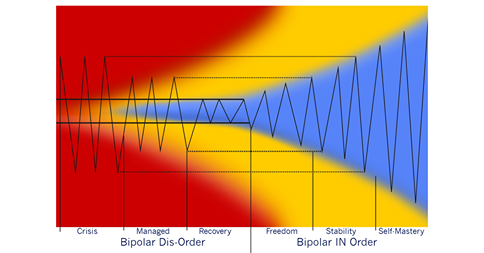
Most of us understand that bipolar disorder involves highs and lows. What is less often discussed is that there is a wide spectrum of how we relate to those highs and lows — and that where we are on that spectrum determines much about our quality of life.
The Bipolar IN Order framework describes six stages of this spectrum. Understanding which stage you are in helps clarify what kind of work is most useful right now, and what is possible over time with sustained effort and appropriate support.
Understanding the Spectrum
The distance from our personal center — emotionally, mentally, physically, spiritually, socially, financially — varies constantly. What matters is not the distance itself but how we handle it. Two people can be at the same intensity level; one is perfectly functional and comfortable, the other is in genuine crisis. The difference lies in the relationship to the state, not the state itself.
The six stages map this relationship from disorder to order.
The Three Disorder Stages
Stage 1: Crisis
In Crisis, the intensity of a high or low state overwhelms our ability to function and stay safe. During a depressive crisis, we may be unable to function at all, or may be at risk of suicide. During a manic crisis, we lose control of our behavior and may put ourselves or others at serious risk.
Crisis requires crisis care: clinical intervention, hospitalization if necessary, and immediate stabilization. Nothing else is appropriate at this stage.
Stage 2: Managed
Most people who identify as having Bipolar Disorder spend most of their time in the Managed Stage. They use medication, therapy, and other tools to keep the intensity from reaching crisis level. They still experience significant discomfort, but the goal is to prevent the worst outcomes. The primary aim of the Managed Stage is to keep things from getting worse.
Stage 3: Recovery
The National Institute of Mental Health defines recovery as the reduction or removal of manic and depressive episodes. For people in Recovery, the acute symptoms have been brought under control. This feels like the destination — and for many years, the mental health field treated it as such.
The challenge is that NIMH's own landmark STEP-BD study found recovery to be an unstable state: "In spite of modern, evidence-based treatment, bipolar disorder remains a highly recurrent, predominantly depressive illness." Recovery, in other words, is a valuable accomplishment but not a permanent one. People who treat it as the final destination are often poorly prepared for the next cycle.
The Three IN Order Stages
Stage 4: Freedom
Freedom Stage begins when someone stops trying to hold on to remission and starts expanding what they can handle. Instead of using tools only to reduce intensity, they begin using tools to function at greater intensity — to move slightly outside their comfort zone in a structured way, and then return.
With practice, people in Freedom Stage become comfortable and functional at intensities that once felt completely unmanageable. The goal shifts from avoiding difficulty to developing greater capacity.
Stage 5: Stability
Stability is achieved when someone can function well at intensities that once caused full crisis. This is a significant accomplishment that takes serious work and time. The person is still bipolar — the states still occur — but they are no longer in disorder. They are comfortable during states that once disabled them, and the people around them experience much less disruption.
Stability Stage is the evidence that moving beyond the disorder model is genuinely possible. Many people have achieved it.
Stage 6: Self-Mastery
Self-Mastery is achieved by those willing to go further still. At this stage, a person can function effectively even during intensities beyond what once caused crisis. They understand rather than resist all of their states, and see genuine value in every one of them.
A useful analogy: the difference between a casual hiker and someone who climbs the Himalayas. Both are hikers. But the mastery involved, and what it requires and produces, is qualitatively different.
Not everyone aspires to Self-Mastery, and that is entirely appropriate. The gains available at Freedom and Stability Stage are substantial and meaningful. Self-Mastery is the upper limit of what is possible — a reference point, not a requirement.
Why the Stages Matter
The stage someone is in determines what is appropriate for them right now. The tools and goals for someone in Crisis are entirely different from the tools and goals for someone in Managed Stage, which are different again from Freedom Stage.
One of the most common mistakes in working with bipolar disorder is applying the tools of one stage to someone in a different stage. Teaching someone in acute crisis how to expand their comfort zone is not just unhelpful; it can be harmful. Treating someone in Stability Stage as though their only goal should be keeping the intensity low sells them short.
Knowing your stage is the beginning of knowing what kind of help is genuinely useful for you right now.