Awareness of bipolar disorder — as a social and clinical goal — has grown significantly over the past twenty years. More people recognize the term, more public figures discuss their diagnoses, and the general population's familiarity with the basic features of the condition has increased substantially.
But there is a significant gap between general awareness of bipolar disorder and the specific, detailed, actionable self-awareness that actually helps people manage the condition better.
Two Kinds of Awareness
The first kind — general awareness — matters for reducing stigma, increasing help-seeking, and creating the social environment in which people are willing to discuss mental health challenges openly. This work has real value.
The second kind — specific self-awareness about your own condition, your own patterns, your own states — is what actually changes daily experience and long-term outcomes.
The Bipolar IN Order framework is primarily concerned with the second kind.
What Specific Self-Awareness Looks Like
Specific self-awareness about bipolar disorder includes:
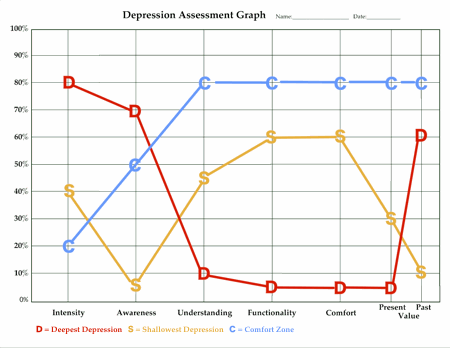
Knowing your states from the inside. Not just the clinical labels — "I was hypomanic" or "I had a depressive episode" — but the actual internal experience of each state. What does 20% elevated feel like for you, specifically? What are the physical sensations, the quality of thinking, the emotional texture? Can you describe it accurately enough that you would recognize it reliably if it arrived?
Knowing your early signals. Before a state becomes clearly recognizable, there are usually precursors. Subtle changes in sleep, shifts in thinking speed, changes in how social interaction feels, specific physical sensations. Knowing your personal early signals — the ones that arrive before the state is obvious — is enormously useful for early intervention.
Knowing your pattern. How do your episodes typically progress? What is the relationship between your depressive and elevated states? Do you tend to move from depression into hypomania? Do you have mixed states? Is there a predictable seasonal component? Your pattern is personal and worth studying.
Knowing what helps and what does not. This sounds obvious, but many people have only a general sense of "these things help" without the specific knowledge of what works at which intensity, under which conditions, at which point in the cycle. Specificity here is what makes tools actually useful.
How This Awareness Develops
The specific self-awareness that is useful in bipolar management does not develop automatically. It develops through deliberate, structured practice over time.
This includes: keeping honest records of states, triggers, and responses; working with assessment tools that ask detailed questions about experience rather than only about symptoms; and engaging regularly with the practice of observation — noticing what is happening internally and building an accurate vocabulary for it.
Clinical treatment supports this development but does not automatically produce it. Therapy can help, particularly approaches that specifically target self-awareness and emotional recognition. The Bipolar IN Order program provides structured frameworks for this kind of development.
Why Awareness Changes Outcomes
The practical reason this matters: awareness is the prerequisite for everything else that is useful in bipolar management.
If you cannot recognize that you are in an elevated state until the state is already intense enough to impair judgment, the window for effective self-intervention has largely closed. If you cannot recognize early depressive signals until you are already significantly impaired, you have lost the most productive time for reaching out to your treatment team and activating supports.
Better awareness means earlier recognition, which means more available lead time, which means more effective response. The chain from awareness to outcome is direct.