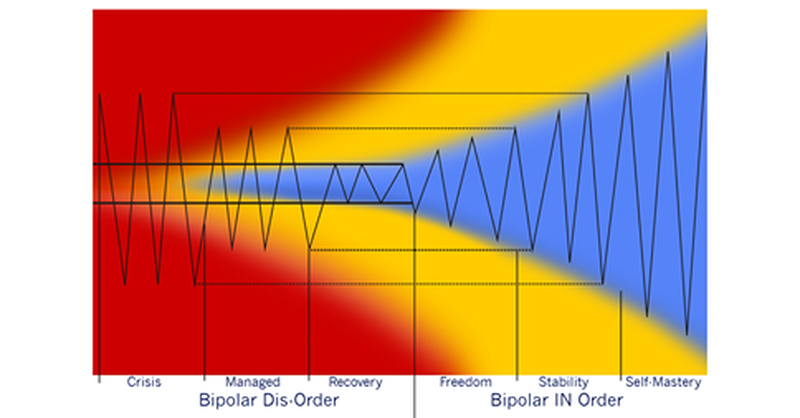
The Bipolar IN Order program is an educational framework for people with bipolar disorder who want to move beyond crisis management and symptom reduction toward genuine functionality across the full range of their experience.
This overview explains what the program is, what it is not, and what it offers.
The Core Premise
The standard model of bipolar treatment aims primarily at reducing the frequency and severity of manic and depressive episodes — bringing the highs lower, the lows higher, and the overall state closer to a stable baseline. This is necessary and important work.
But the Bipolar IN Order framework starts from a different question: What if, alongside reducing the intensity and frequency of difficult states, we also built the capacity to function within them when they occur?
These two goals are not in competition. Clinical management — medication, therapy, lifestyle — creates the foundation that makes skills development possible. Skills development, in turn, makes the benefits of clinical management more durable and more meaningful.
The Bipolar IN Order approach adds the second goal to the first. The result, for people who do the sustained work, is a qualitatively different relationship to the condition.
The Six-Stage Framework
The program is organized around a six-stage model describing the path from disorder to order:
Crisis Stage — Episodes are overwhelming and creating genuine danger. Clinical intervention is the priority; skills development is not appropriate here.
Managed Stage — Tools are being used to keep episodes below crisis level. Clinical care remains primary.
Recovery Stage — Symptoms have reduced to near-absence (remission). This is an important milestone and the appropriate goal of first-line clinical treatment.
Freedom Stage — Building on the stability of Recovery, deliberate graduated steps outside the comfort zone begin. The person learns to take small, supervised excursions into slightly elevated states and return to baseline using their own skills.
Stability Stage — The person can function well at intensities that once caused full crisis. The condition is still present, but it is no longer in disorder.
Self-Mastery Stage — The highest stage: the person can function effectively at near-maximum intensities. This is the advanced stage, reached by those who invest the most sustained work over the longest period.
What the Program Teaches
The Bipolar IN Order curriculum addresses several interconnected areas:
Self-assessment — Learning to recognize your states accurately, in real time, across a meaningful range of intensity. This includes learning to describe each intensity level specifically — what it feels like physically, mentally, emotionally, spiritually, socially, and practically.
Toolkit development — Building a personalized set of tools, practiced during stable periods, that are available across the full range of experience. The toolkit addresses all six dimensions of experience and is tested and refined through deliberate practice.
Comfort zone expansion — The structured, graduated practice of stepping slightly outside the current comfortable range and returning using skills. This is the mechanism by which the comfort zone expands over time.
Functionality measurement — Learning to measure progress not only by episode frequency and severity but by the quality of functioning during difficult states. This provides a more complete picture of progress.
Stage-specific planning — Understanding what kind of work is appropriate at each stage and building plans accordingly. Different stages call for different tools and different goals.
What the Program Is Not
The Bipolar IN Order program is not a substitute for clinical care. It does not replace medication management, therapy, or other clinical interventions. Everything in the program is designed to be pursued alongside professional clinical support, not instead of it.
It is not a quick fix. The stages of growth take time — typically years of sustained practice. There is no shortcut from disorder to self-mastery.
And it is not appropriate for everyone at every point in their journey. The advanced skills work in the program is most appropriate for people who have established clinical stability — who are in Recovery Stage or beyond. People in Crisis or Managed Stage need clinical support first.
Who It Is For
The Bipolar IN Order program is designed for people with bipolar disorder who have an established clinical foundation and are ready to invest in developing their capacity beyond management and recovery. It is also valuable for the families, partners, and support people of those with bipolar disorder, and for clinicians who want a more complete framework for understanding their patients' possibilities.